
Sensory-Friendly Classroom Setup: A Teacher’s Toolkit (with Free Printables)

You already care. You wouldn’t be reading this otherwise. So let’s skip the “be patient” reminders and get into the tactical stuff — the room setup, the cheap fixes, the printables you can use tomorrow, and the things to stop doing today. This guide is teacher-to-teacher. It’s for the K-8 classroom teacher juggling 27 kids, the para who knows the room better than anyone, the counselor pulled in three directions, and the sub keeping things steady in someone else’s space. We’re focused on supporting autistic students and neurodivergent learners broadly — but every veteran teacher already knows the truth: a sensory-friendly classroom helps every kid in the room. Universal design is just good teaching. ## TL;DR for the time-strapped teacher
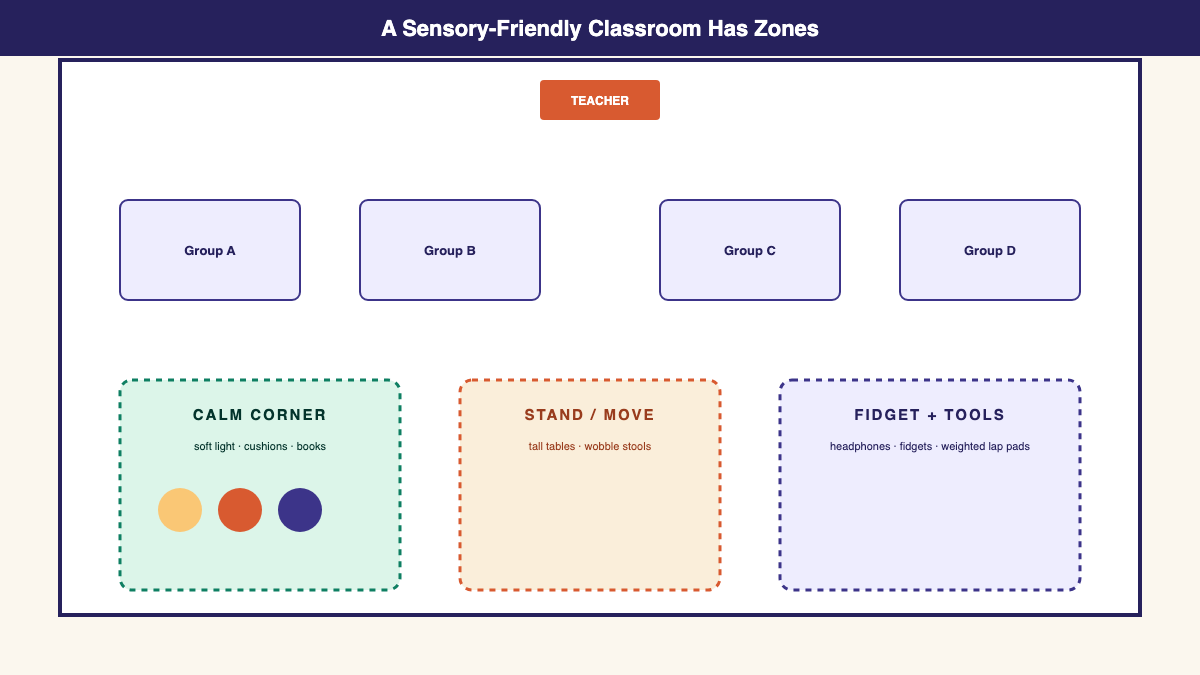
Overhead view of a sensory-friendly classroom: teacher desk at top, four group tables, calm corner, stand-and-move zone, and a fidget tools area
A sensory-friendly classroom builds in zones: calm corner, stand-and-move space, fidget tools — all visible from the teacher’s desk.
– Design for four sensory channels: visual, auditory, proprioceptive, vestibular. – The cheapest sensory-friendly classroom upgrades cost zero dollars: lower the lights, declutter the walls, build a calm corner from what you already have. – Grab the free printables linked below — they’re built for inclusive classrooms and work as-is. – Use silent visual timers and decision wheels instead of loud buzzers. – Stop using compliance sticker charts, stop forcing eye contact, and stop sending kids in meltdown to time-out. None of these things do what they claim to do. – Talk to families like partners, not problems. Use identity-first language unless they tell you otherwise. ## The 4 sensory channels you should design for Every classroom sends sensory signals whether you mean to or not. Designing the room intentionally takes ten minutes and pays you back for the rest of the year. **Visual.** Fluorescent overheads flicker at a rate most adults tune out but many autistic and ADHD students cannot. Anchor charts stacked floor-to-ceiling compete with whatever you’re teaching. Fixes: swap a tube for a warm LED or use a floor lamp, rotate anchor charts so only current-unit material stays up, and leave one wall mostly blank as a visual rest zone. **Auditory.** A room with hard floors and cinder block walls is an echo chamber. Fixes: tennis balls on chair feet (free if maintenance has dead ones), a rug remnant in the calm corner, noise-canceling headphones on a labeled hook by the door, and a “noise meter” visual students self-monitor against. **Proprioceptive.** The body-awareness channel — input from your muscles and joints when you push, pull, or carry something heavy. Many students who look “fidgety” are seeking proprioceptive input. Fixes: wall push-ups as a transition, a basket of heavy books a student can “deliver” to the office, resistance bands tied around chair legs, and lap weights (a bag of rice in a pillowcase works). **Vestibular.** Balance and movement. Seekers need to rock, spin, or sway; avoiders need stability. Fixes: wobble cushions or a stability ball for one or two seats, a rocking chair in the calm corner, and brain breaks every 20 minutes with real cross-body movement — not just “stand and stretch.” ## Quick wins for Monday morning
Diagram of the four sensory channels every classroom should design for: visual, auditory, proprioceptive, vestibular
The four channels every classroom should design for. Get these right and behavior issues fall.
You don’t need a renovation budget. You need ten minutes and a willingness to move some furniture. 1. **Swap the overheads.** Replace one fluorescent tube with a warm LED, or kill the overheads entirely and run lamps. Test it for a week and watch what happens to the room’s energy. 2. **Build a fidget bin.** Stress balls, putty, tangles, chenille stems. Available to anyone, no permission needed. Label it. Trust kids to use it. 3. **Add alternative seating.** One wobble stool, one floor cushion, one standing spot at a counter. Rotate weekly so it doesn’t become “so-and-so’s chair.” 4. **Headphones on a hook.** Noise-canceling or noise-reducing, hung by the door, available to grab without asking permission. The ask-permission step is a barrier that defeats the purpose. 5. **Visual schedule, posted at kid-eye-level.** Picture + word for K-2, word + time for 3-8. Update it daily. Cross things off as you go. 6. **A “break” card on every desk.** A laminated card the student can place face-up to signal they need a break without speaking. This single intervention can prevent more meltdowns than any reward chart ever will. 7. **Dim the digital.** Set your projector and smartboard to a lower brightness. The default factory settings are calibrated for showrooms, not classrooms. 8. **Declutter one wall.** Pick the wall behind where you teach. Take down everything that isn’t immediately useful. The kids facing you will thank you with their attention. 9. **Predictable transitions.** Two-minute warning, one-minute, transition. Same script every time, silent visual timer, no buzzer. 10. **A “yes” basket by the door.** Pencils, tissues, sanitizer, a granola bar — things kids might need but are afraid to ask for. Removing the ask removes a sensory and social load. ## Build a calm corner without spending a dime You don’t need a Pinterest-perfect “regulation station” with a fake tree and a chalkboard sign. You need a corner of the room that signals “this is a safe place to settle.” Pick the quietest corner — usually opposite the door and away from the HVAC vent. Put a rug down (any rug, even a bathmat). Add a beanbag or a folded blanket. Lean a piece of fabric or a tri-fold display board to create a visual barrier on one side. That’s the structure. Inside, put: a few books, a small basket of fidgets, headphones, a feelings chart, and a simple visual of regulation strategies (breathe, push the wall, count to ten, drink water). Add a sand timer so a student knows how long they have. Five minutes is plenty. Rules: any student can use it, no permission needed, no questions on the way back. It is not a punishment space or a reward space. It’s a regulation space. If a student is using it often, that’s data — not a behavior problem. Cost: zero if you scavenge. Under twenty dollars if you don’t. ## Free printables for your sensory-friendly classroom
Grid of 8 quick classroom upgrades teachers can do this week: warm LEDs, fidget bin, wobble seat, headphones, tennis balls on chair legs, weighted lap pad, calm corner, visual timer
Eight upgrades a teacher can implement this week with no admin approval.
Every printable below is free and built for inclusive K-8 classrooms. Print, laminate, and use as-is. – **[Mindfulness & SEL Pack](https://www.notjustapuzzle.com/product/mindfulness-sel-pack/)** — breathing exercises, feelings charts, regulation strategy cards. Drop them straight into the calm corner. – **[Indoor Recess Mega-Pack](https://www.notjustapuzzle.com/product/indoor-recess-mega-pack/)** — low-stimulation activities for the days when the gym is full and the weather is terrible. Quiet alternatives to the usual loud free-for-all. – **[Substitute Teacher Survival Kit](https://www.notjustapuzzle.com/product/substitute-teacher-survival-kit/)** — a sub folder template that includes sensory notes for your students. The kid having a hard day shouldn’t have to start over because the sub doesn’t know. – **[Behavior + Reward Chart Templates Pack](https://www.notjustapuzzle.com/product/behavior-reward-chart-templates-pack/)** — strengths-based, goal-tracking templates. (Use these for skill-building, not compliance. More on that below.) – **[Curriculum Word Search Packs](https://www.notjustapuzzle.com/product-category/teachers-resources/)** — four packs covering Math, Science, Vocabulary, and Social Studies. Quiet independent work that doubles as a sensory break from group instruction. ## Digital tools that don’t add sensory load The wrong digital tool screams at the room. The right one quietly does its job. – **[Visual Timer in Classroom Tools](https://www.notjustapuzzle.com/classroom-tools/)** — silent, color-coded countdown. The kid who can’t process the verbal “two more minutes” can see exactly how much time is left. – **[Pomodoro Timer](https://www.notjustapuzzle.com/pomodoro-timer/)** — work-break-work cycles that respect attention spans. Great for upper elementary and middle school independent work. – **[Stopwatch + Timer](https://www.notjustapuzzle.com/stopwatch/)** — clean interface, no flashing, no audio jump-scares. Use for transitions and timed activities. – **[Decision Wheel](https://www.notjustapuzzle.com/decision-wheel/)** — a silent picker for choosing students, partners, or activities. No more booming “OK, who hasn’t gone yet?” – **[Color Palette Generator](https://www.notjustapuzzle.com/color-palette-generator/)** — use it to pick calming color schemes for slides, anchor charts, and bulletin boards. Avoid the high-contrast neon defaults. ## What NOT to do This is the honest part. Some practices are common in classrooms and still cause harm. – **Don’t use compliance sticker charts.** Public charts that rank student behavior shame the kids who most need support, and they teach masking — not regulation. If you use a chart, make it private, goal-based, and the student’s own. – **Don’t force eye contact.** For many autistic students, eye contact is physically uncomfortable and reduces — not increases — their ability to listen. “Look at me when I’m talking to you” is the opposite of an accommodation. – **Don’t send a kid in meltdown to time-out.** A meltdown is a nervous-system event, not a behavior choice. Removing the child mid-meltdown often escalates it. Offer the calm corner, lower your voice, reduce demands, and wait. – **Don’t recommend ABA.** Plenty of autistic adults have written about why. If a family asks, listen to them, and point them toward neurodiversity-affirming therapists and speech-language pathologists instead. – **Don’t use the puzzle-piece symbol.** Many autistic people find it dehumanizing — it implies something is missing. The rainbow infinity symbol is widely preferred by the autistic community. (Yes, this site is called Not Just a Puzzle for a reason.) – **Don’t promise a “quiet classroom.”** That’s not the goal. The goal is a *regulated* classroom, which sometimes includes humming, rocking, stimming, and movement. Those are features, not bugs. **A quick sidebar on the puzzle piece.** You’ll still see it on awareness merch and old curriculum materials. Most autistic self-advocates have moved away from it: it was originally designed around the idea that autistic people are a problem to be solved, and the brands most associated with it have a long history of speaking *about* autistic people rather than *with* them. The gold infinity symbol (autism) and rainbow infinity (neurodiversity broadly) are what you’ll see in current advocacy work. ## Talking to families: language that builds trust Families have been talked at by schools for years. The fastest way to earn trust is to talk *with* them, like a colleague. A few language moves that go a long way: – **Use identity-first language by default.** “Autistic student” rather than “student with autism.” Most autistic adults prefer it. If a family or student tells you they prefer person-first (“with autism”), use that. Ask. Don’t assume. – **Skip the deficit framing.** Instead of “He struggles with transitions,” try “Transitions are a hard part of his day — here’s what’s working.” Same information, different relationship. – **Name what you’re trying.** “We’re testing a visual schedule and a break card this week. I’ll let you know what we see.” Families want to know you’re being thoughtful, not winging it. – **Avoid jargon.** “Proprioceptive input” is fine in your team meeting. With a parent, say “heavy work — pushing, pulling, carrying things.” Same concept, no gatekeeping. – **Acknowledge what’s hard at home.** Many families are running the same playbook in a smaller space with less help. Ask what’s working there. Borrow it. ## FAQ **What’s the cheapest sensory upgrade for a classroom?** Turning off the overhead fluorescents. It costs nothing, takes one second, and changes the entire feel of the room. Pair it with one or two warm lamps and you’ve made a meaningful sensory accommodation in under a minute. **How do I get my admin to fund this?** Frame it in their language: behavior referrals, time off-task, and instructional minutes lost to dysregulation. A two-hundred-dollar investment in seating and lighting often pays for itself in fewer office visits within a quarter. Bring data, not vibes. And be honest with yourself — schools chronically under-resource this work, and a lot of the lift will fall on you regardless. Build for what you can control first. **Do these accommodations help non-autistic kids too?** Yes — that’s the universal design point. Lower lighting, predictable transitions, alternative seating, and silent timers help students with ADHD, anxiety, trauma histories, sensory processing differences, English language learners, kids who didn’t sleep last night, and frankly, you. A sensory-friendly classroom is just a well-designed classroom. **How do I handle pushback from other parents?** “Why does he get a wobble chair and my kid doesn’t?” The honest answer: any kid can use the wobble chair on a rotation, and the accommodations in this room are available to everyone who benefits from them. You’re not giving one student a privilege; you’re designing a room that works for more brains. Most parents soften when they hear that. **What about secondary teachers — can this scale?** Yes, with adjustments. You won’t have your own room, so you can’t redesign the space. But you can keep a sensory kit in a rolling cart (headphones, fidgets, break cards, visual timers), use silent digital tools across every class, build predictable openers and closers, and skip the public behavior charts. The principles travel; the props get smaller. **What if I’m a sub walking in cold?** Read the sub folder first — sensory notes should be in it. (Regular teachers: that’s why we built the [Substitute Teacher Survival Kit](https://www.notjustapuzzle.com/product/substitute-teacher-survival-kit/).) Default to lower lights, quieter transitions, and giving any student who asks for a break exactly that. You won’t undo a year of work in one day, but you can keep the room steady. ## Start with one change this week Don’t try to do all of this. Pick one Monday-morning win and one printable. Run them for a week. Notice what changes. Then add the next. Browse the full library of free, teacher-built classroom resources at **[notjustapuzzle.com/free-downloads/](https://www.notjustapuzzle.com/free-downloads/)** — printables, visual timers, decision wheels, and the rest of the toolkit. All free. No email gate. The kids are lucky you read this far. —

⚡ Reader Club · Free Forever

Join 100s of readers getting puzzle + parenting tips by email.

One short email a week. Free printables, new tools, behind-the-scenes. Unsubscribe anytime.

5 free printables 1 short email/week No spam, ever