
Calm-Down Activities That Actually Work for Autistic Kids (No Bright Lights, No Loud Bells)
If you’ve landed here, you’re probably looking for something quieter than the standard advice. Maybe the flashing timer made things worse. Maybe the “calm-down playlist” with chimes startled your kid into tears. Maybe a well-meaning poster told you to count to ten with a child who is already past words.
This guide is for parents and teachers who want calm-down activities that actually fit how autistic kids experience the world — low-input, predictable, respectful, and grounded in what the autistic community has been saying for years. No bright lights. No loud bells. No fixing.
TL;DR
- A meltdown is not a tantrum. It’s an involuntary response to overload — not something a child is choosing, and not something they can “stop” on command.
- Your job isn’t to regulate them — it’s to make regulating easier. Lower the sensory input, protect their space, and let stimming do its work.
- Quiet, repetitive, visual activities help most. Mandalas, mazes, color-by-number, soft visual timers, and a predictable “calm corner” beat any noisy intervention.
Meltdown ≠ tantrum — why the distinction matters
The single most important shift in supporting an autistic child is understanding that a meltdown is not a behavior problem. It’s a nervous-system response to too much input — sensory, social, emotional, or all three stacked on top of each other.
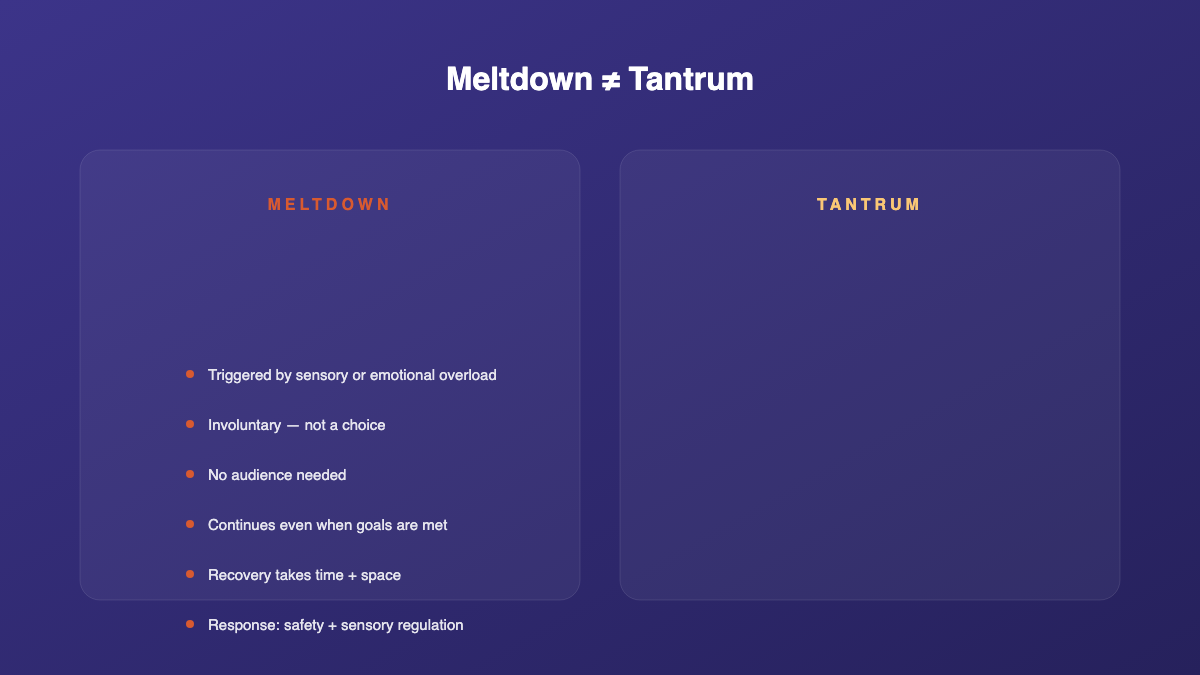
A tantrum is goal-directed. A child having a tantrum is, at some level, watching to see if it’s working. They can stop if the goal is met or the audience leaves.
A meltdown is not goal-directed. There is no audience-check. The child cannot stop it any more than you can stop a sneeze mid-sneeze. Asking “what do you want?” during a meltdown is like asking someone with a migraine to do long division. The system is offline.
Some autistic kids experience the opposite — a shutdown. Instead of escalating outward, they go quiet, still, unresponsive. This is the same overload response in a different direction, and it deserves the same gentle treatment: less input, more space, no demands.
Once you internalize that meltdowns and shutdowns aren’t choices, the whole approach changes. You stop trying to win them and start trying to make the environment survivable.
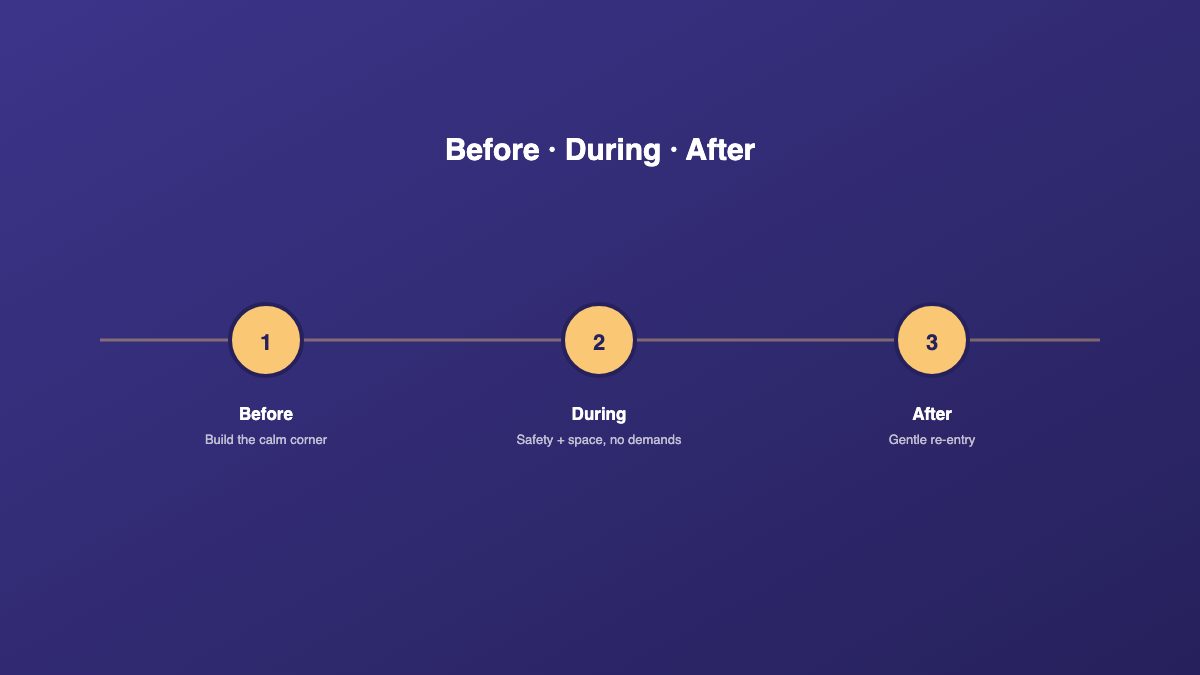
What helps DURING a meltdown
When a meltdown is already happening, the goal is not to teach, redirect, or reason. The goal is to lower the load and keep your child safe until their system comes back online.
- Reduce input first. Dim the lights, mute the TV, close the door, ask siblings to step out. Every sense you quiet is one less thing the nervous system has to process.
- Drop your voice. Quieter, slower, lower. If you must speak, use short phrases: “I’m here.” “You’re safe.” “Take your time.” Long sentences are noise.
- Give physical space, not closeness. Many autistic kids cannot tolerate touch during overload, even from a parent they love. Sit nearby, not on top of them. Let them come to you.
- Let stimming happen. Rocking, flapping, humming, pacing, scripting — these are not the meltdown. They are the regulation. Interrupting a stim is interrupting recovery.
- Move dangerous objects, not the child. If safety is the concern, change the room rather than restraining the body.
- Offer, don’t impose. A weighted blanket within reach is help. A weighted blanket dropped on a child mid-meltdown is another sensory assault.
What does not help: bright “calm” lamps, sudden timers, chimes, “use your words,” counting down, eye contact requests, or any version of “you need to calm down right now.” All of these add input. The math is simple — overload plus more input equals more overload.
What helps BEFORE — building a calm corner
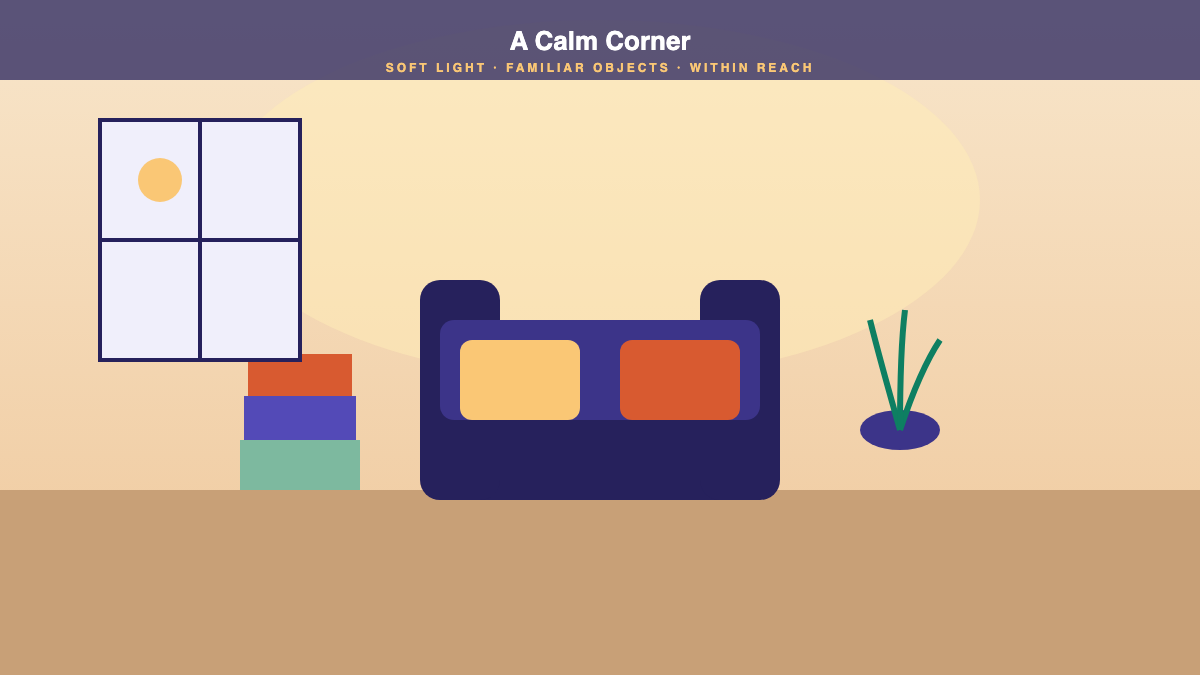
The best meltdown response is the one you don’t need, because the environment did the work first. A calm corner is a predictable, low-sensory spot a child can use whenever they feel the pressure building — not a punishment seat, not a “go calm down” exile, but a space they choose.
What goes in a good calm corner:
- Soft, dim lighting. A small warm-bulb lamp or salt lamp, not overhead fluorescents. No flashing or color-changing lights.
- One or two textures they like. A specific blanket, a beanbag, a soft pillow. Autistic kids often have strong preferences — ask them, don’t guess.
- Noise control. Ear defenders, loop earplugs, or noise-cancelling headphones. Sometimes silence; sometimes a single familiar sound on loop.
- Quiet, repetitive visual activities. Coloring, mazes, pattern work. Predictable, finite, and demand-free.
- A visual cue for “I need space.” A card, a sign on the door, a chosen object placed on a shelf. Words are expensive during dysregulation; symbols are cheap.
- Nothing that surprises them. No motion-activated anything. No timers that beep. No music that suddenly switches tracks.
For classrooms, the same logic applies on a smaller scale: a low-stimulation corner with a beanbag, ear defenders, a clipboard with a maze or mandala, and a visible “in use” sign so the child has privacy.
What helps AFTER — gentle re-entry
The hour after a meltdown is often harder than the meltdown itself. Many autistic kids feel raw, embarrassed, exhausted, or physically sore. This is not the moment for a debrief.
- Don’t talk about it yet. Offer water, a snack, a blanket. Conversation about what happened can come tomorrow, or in a week, or never — let the child lead.
- Lower expectations for the rest of the day. A meltdown is a full-body event. Plan for rest, not productivity. Skip the homework if you can.
- Re-enter through routine. Familiar food, familiar show, familiar order of events. Predictability is repair.
- Don’t apologize on their behalf. If others were present, you don’t need to perform shame for them. “She had a hard moment, she’s resting now” is enough.
- Note what preceded it. Not to assign blame, but to spot patterns. Was it the supermarket lights? A schedule change? A skipped meal? Patterns reduce future meltdowns more than any in-the-moment trick.
8 free, low-sensory tools you can use right now
Every tool below is free, browser-based, and designed without flashing lights, autoplay sound, or surprise alerts. Bookmark the ones that fit your kid.
- Mandala Coloring. Repetitive, symmetrical, predictable. Mandalas give the visual system something orderly to settle into. Print one or color on screen.
- Color by Number. The “what do I do next” question is already answered, which is exactly what an overloaded brain wants. Pure, low-decision focus.
- Calming Mazes. Finite path, clear goal, no surprises. Generate easy ones for younger kids or anyone post-meltdown; harder ones when capacity is higher.
- Pomodoro Timer. A gentle visual timer for kids who do better when they can see time, not hear it. No loud bell at the end — just a quiet transition.
- Visual Timer in Classroom Tools. For teachers — a quiet, classroom-friendly visual countdown, plus other low-stim classroom helpers.
- Affirmation of the Day. A single short, kind sentence. Useful for kids who like reading or who use affirmations as part of their morning routine.
- Mindfulness & SEL Pack (free printable). Printable pages covering feelings, breathing, and grounding — useful for the calm corner or the classroom quiet shelf.
- Behavior + Reward Chart Templates. Honest note: these work best as visual schedules and predictability tools, not as carrots. Use them to show the day, not to bribe regulation.
Sensory-safe stim ideas to encourage, not discourage
Stimming is regulation. Full stop. The autistic community has been saying this for decades, and the research is increasingly catching up: self-stimulatory behavior is how many autistic people process input, manage emotion, and stay in their bodies. Suppressing stims doesn’t make a child less autistic — it just makes them less regulated and, often, more anxious.
What you can do is help your child build a personal toolkit of stims that work for them and don’t hurt anyone. Some options to offer (not require):
- Chewable jewellery or chew tubes for oral seekers
- Fidget rings, putty, kinetic sand, or a smooth worry stone
- Weighted lap pads or a snug compression vest
- Rocking chairs, swings, or a soft bouncing surface
- Humming, scripting, echolalia — these are language stims and they’re fine
- Visual stims: lava bottles, kaleidoscopes, slow snow globes (avoid flashing or strobing)
- Hand flapping, finger flicking, spinning — these need no replacement; they need a safe place
If a stim is genuinely unsafe — head-banging, skin-picking, anything causing injury — that’s worth talking to a professional about, not because the stim itself is wrong, but because the level of distress driving it deserves real support. Replace function with function, not stim with stillness.
When to seek help
Most meltdowns, even hard ones, are part of being autistic in a world that wasn’t built for autistic nervous systems. They’re not a sign you’re failing or that your child needs to be fixed.
That said, it’s reasonable to bring in support when:
- Meltdowns or shutdowns are happening daily and clearly exhausting your child
- Your child is causing real harm to themselves and you don’t have tools that help
- You’re seeing a sharp change — new triggers, longer recovery, withdrawal — that doesn’t match their baseline
- You’re running on empty and need someone in your corner too
Good help looks like an autistic-affirming occupational therapist, a neurodiversity-affirming psychologist, a speech-language pathologist who respects AAC and gestalt language, or a peer-support community of other autistic adults and parents. Look for providers who center the autistic person’s experience, not compliance.
FAQ
What’s the difference between a meltdown and a tantrum?
A tantrum is goal-directed — a child is trying to get something, and the behavior usually stops when the goal is met or the audience leaves. A meltdown is an involuntary nervous-system response to overload. It is not a choice, it is not strategic, and it cannot be stopped on demand. The right response to a tantrum is calm boundaries; the right response to a meltdown is reduced input and safety.
Should I let my autistic child stim?
Yes. Stimming is regulation, not a problem to fix. It helps with focus, emotional processing, and sensory balance. The only reason to redirect a stim is if it’s causing physical harm, and even then, the goal is a safer outlet — not stillness. Hand flapping, rocking, humming, and similar stims are healthy and should be welcomed at home and at school.
What’s a “calm corner” and how do I build one?
A calm corner is a low-sensory, predictable space a child can choose to use when they feel overload building. Build one with soft warm light, a known texture (blanket or beanbag), noise-reducing headphones, and quiet repetitive activities like mandalas or mazes. Keep it consistent — same spot, same items — and make it clear the corner is never a punishment.
How can I help during a meltdown without making it worse?
Lower the input before anything else: dim lights, mute sound, give space. Drop your voice and keep words short. Don’t ask questions, don’t require eye contact, don’t try to teach. Stay nearby for safety but don’t impose touch. Let stimming happen — it’s how your child is coming back to themselves.
Why do bright timers and loud bells backfire?
For an already-overloaded sensory system, a bright flash or sudden bell is another assault, not a helpful cue. Even “fun” alerts can spike a dysregulated nervous system back into overload. Quiet visual timers, soft transitions, and predictable warnings work far better than anything designed to grab attention.
Is it okay to use a reward chart with an autistic child?
Reward charts work well as visual schedules — “here’s what the day looks like, here’s what’s next.” They work poorly as bribes for regulation, because regulation isn’t something a child is withholding. Use charts to add predictability, not to extract behavior.
One last thing
You don’t need a perfectly designed sensory room or a shelf full of gear. You need a quiet corner, a few predictable activities, a willingness to let your child stim, and the understanding that meltdowns are weather, not character. Everything else is a bonus.
If you’d like a starting kit, our free downloads page has printable mandalas, mazes, visual schedules, and the Mindfulness & SEL pack — all designed to be low-sensory, no-frills, and ready to drop into your calm corner today.
⚡ Reader Club · Free Forever
Join 100s of readers getting puzzle + parenting tips by email.
One short email a week. Free printables, new tools, behind-the-scenes. Unsubscribe anytime.