Daily Rituals That Help Autistic Adults Thrive (No Self-Help Nonsense)
If you’ve ever tried to follow a “miracle morning” routine and quietly hated yourself by Wednesday, this post is for you. Most autistic adult routines advice on the internet is written for neurotypical people who find novelty energizing and willpower renewable. We don’t, and it isn’t. This is a peer-voice piece. It isn’t a clinical guide. It’s a working set of ideas about what helps an autism daily routine feel less like a job and more like a soft place to land.Who this is for
Why generic self-care advice fails autistic adults
Generic autistic adult self care content tends to assume three things that aren’t true for a lot of us: 1. **Novelty is energizing.** Most monotropic brains find novelty expensive. Switching focus costs more than the new thing is usually worth. A surprise “fun” activity isn’t a treat, it’s a tax. 2. **Willpower is a renewable resource.** It isn’t. Especially not when sensory load and masking are already eating most of the day’s bandwidth. 3. **Feeling better is the goal.** A lot of us aren’t trying to feel *good* on a Tuesday. We’re trying to feel *steady*. Steady is underrated. Steady is the goal. So when an article says “wake up at 5, journal three pages, cold plunge, gratitude meditation,” what we hear is: *add seven new tasks, four new transitions, and a moral failure clause if you skip any of them.* No thanks. There’s also a quieter problem. A lot of the self-care content aimed at autistic people romanticizes masking — phrased as “showing up” or “putting your best face forward.” We’re not going to do that here. Masking has a cost. It’s correlated with autistic burnout, depression, and a kind of identity erosion that takes years to recover from. You’re allowed to mask when you need to. You’re allowed to stop when you can.Rituals over routines: the small difference that matters
8 free daily tools (we made these for ourselves, you can use them too)
We didn’t build these as a “wellness suite.” We built them because we needed them. Each one is a single-purpose page, no account, no streaks, no guilt timer. Pick one. Use it for a week. Drop the rest. 1. **Quote of the Day** — one sentence in the morning, no commentary. Good if you want a tiny anchor without reading a whole article. 2. **Affirmation of the Day** — short, plain-language, not the “I am a goddess of abundance” variety. If affirmations make you cringe, ours might surprise you. If they still don’t land, skip this one. 3. **Journal Prompt of the Day** — one question. Answer it in two lines, or two pages, or in your head while you brush your teeth. 4. **Riddle of the Day** — a small contained puzzle. Useful when your brain wants something to bite on but you don’t have the bandwidth for a full game. 5. **Joke of the Day** — sometimes you just need a low-effort smile before opening Slack. 6. **Word Guess of the Day** — a five-letter word game. Same shape every day. Great ritual energy. 7. **Pomodoro Timer** — for the days when your only problem is starting. 25 minutes is short enough to bargain with. 8. **Word Counter** — for the writers and the overthinkers. Sometimes you just need to see that you did, in fact, write 412 words today and can stop spiraling. These aren’t magic. They’re small fixed objects in your day. That’s the whole point.The 5-minute reset: how to use a single daily tool well

Burnout recovery: when even tiny rituals are too much
Autistic burnout isn’t regular burnout. It’s a deeper kind of system shutdown — loss of skills you used to have, sensory tolerance dropping to zero, executive function gone, sometimes loss of speech. It’s often the bill that comes due after years of masking, especially for late-diagnosed people who masked without knowing they were doing it. If that’s where you are right now, this section is for you. The rest of this article is not. In real burnout, the goal is not productivity. The goal is not even rituals. The goal is *reduction.* – Cancel everything you can cancel without losing your housing or your job. Yes, really. – Lower sensory input. Lights down. Noise-cancelling on. Smaller world. – Eat the same three meals on rotation. Decision-making is part of the load. – Sleep when you can sleep. Rest when you can’t. – If you do anything ritual-like, make it a 30-second one. The Quote of the Day, read once. Nothing else. – Stop unmasking *and* stop masking with people who require either. Withdraw if you have to. Burnout recovery is measured in months, not days. There is no productivity hack for it. The only way through is less. When you start coming back — and you do come back — add rituals one at a time. Not five. One. Give it two weeks before you add another.Talking about your autism at work (only if you want to)
Sensory overwhelm at work is one of the biggest reasons autistic adults burn out, and one of the least discussed. Fluorescent lights, open offices, surprise meetings, the social cost of small talk, the performance of “engagement” — it’s a tax you pay all day, every day, and most workplaces don’t see it. You don’t owe anyone a disclosure. Late-diagnosed adults especially get pressured into telling everyone immediately. You don’t have to. If you do want to ask for accommodations, you can often get them without using the word “autism” at all. Try framing it as preferences and outcomes: – “I focus best with headphones on. I’d like to make that my default.” – “I do better when meetings have an agenda 24 hours ahead.” – “I’d like to keep cameras-optional on internal calls.” – “I’d like to take lunch alone — it’s how I reset.” If you do disclose, do it on your terms. To a specific person. In writing if you want a record. You are not obligated to educate your whole team. There are organizations whose entire job is that; it doesn’t have to be yours. And one boundary that’s hard but worth it: if your workplace’s culture requires constant masking to survive, that is information about the workplace, not about you.FAQ
Are daily routines really helpful for autistic adults?Predictable structure helps most autistic adults, yes — but the word “routine” is doing a lot of work. Rigid, optimized, productivity-style routines often backfire. Small repeated rituals attached to existing anchors (meals, commutes, the start of the workday) tend to work much better than ambitious morning regimens. What is autistic burnout?
Autistic burnout is a state of long-term exhaustion, loss of skills, and reduced tolerance to sensory and social input, usually caused by sustained masking, unaccommodated environments, or major life changes. It’s distinct from depression and from regular work burnout, though it can co-occur with both. Recovery is measured in months and centers on *reducing* demands, not on adding new self-improvement habits. Why do I crave routine but also hate being told what to do?
You’re not broken or contradictory. Many autistic adults find self-chosen structure deeply regulating and externally-imposed structure deeply distressing. The variable isn’t the structure — it’s the autonomy. Rituals you design for yourself, that you can drop without consequence, tend to feel safe. Routines handed to you by a productivity guru tend to feel like a cage. I’m newly diagnosed — where do I start?
Start by changing nothing for a few weeks. Read autistic adults writing about their own lives (not just clinicians writing about us). Notice which of your existing habits are actually serving you and which were survival strategies you can now let go of. There is no rush. Late diagnosis is, paradoxically, an invitation to slow down — not to optimize yourself in a new direction. Is it okay to mask sometimes?
Yes. Masking is a survival tool, and like any tool, the question is cost. Brief, chosen masking in a job interview or a medical appointment is very different from full-time, all-day masking that erodes who you are. The goal isn’t never masking. The goal is knowing when you’re doing it, choosing it, and having spaces where you absolutely do not have to. What’s the difference between a ritual and a routine for autistic adults?
A routine is a sequence of tasks aimed at output. A ritual is a small repeated act aimed at anchoring. Routines need willpower and break loudly when life interrupts them. Rituals are short, low-stakes, and survive bad weeks. For most autistic adults, rituals are the more sustainable structure.
The quiet close
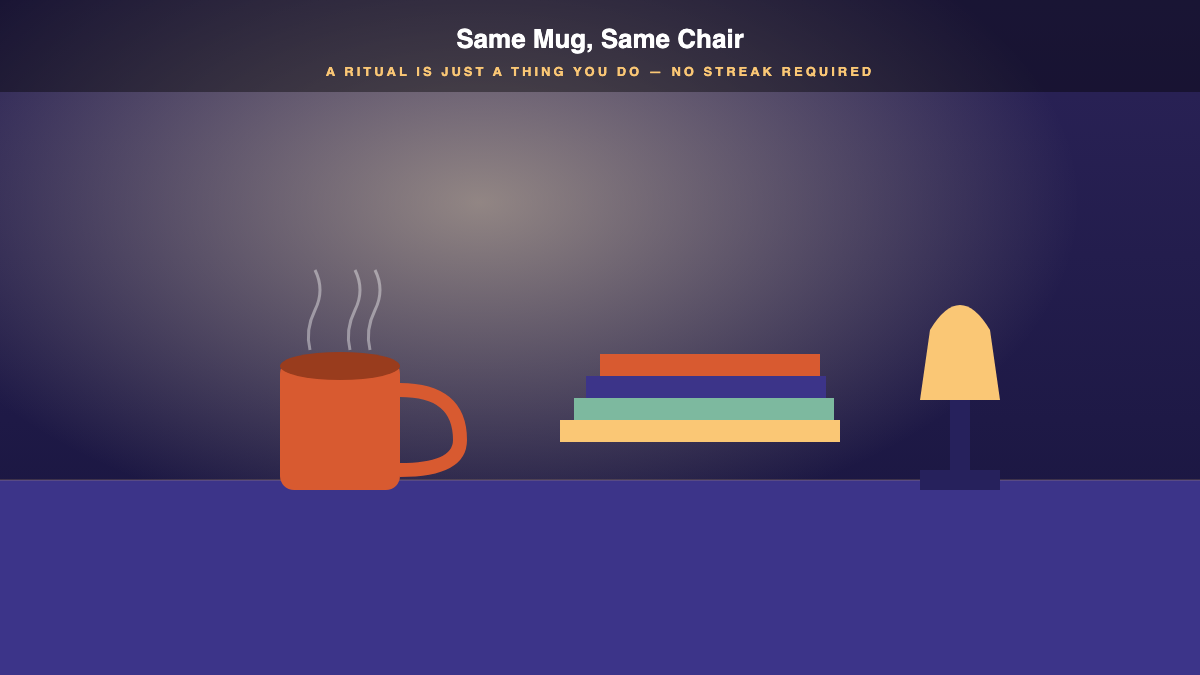
You don’t need a new morning routine. You need a small, fixed thing that’s waiting for you tomorrow whether or not today went well. If any of this resonated, two soft invitations: – Join the Reader Club — occasional emails from the publisher, no streaks, no urgency, easy to leave. – Browse our free downloads — printable journals, prompts, and a few quiet things we made for ourselves first. We’ll be here. Same chair, same mug.⚡ Reader Club · Free Forever
Join 100s of readers getting puzzle + parenting tips by email.
One short email a week. Free printables, new tools, behind-the-scenes. Unsubscribe anytime.
5 free printables
1 short email/week
No spam, ever