
Special Interests Aren’t a Problem — They’re a Strength. Here’s How to Build On Them.
TL;DR
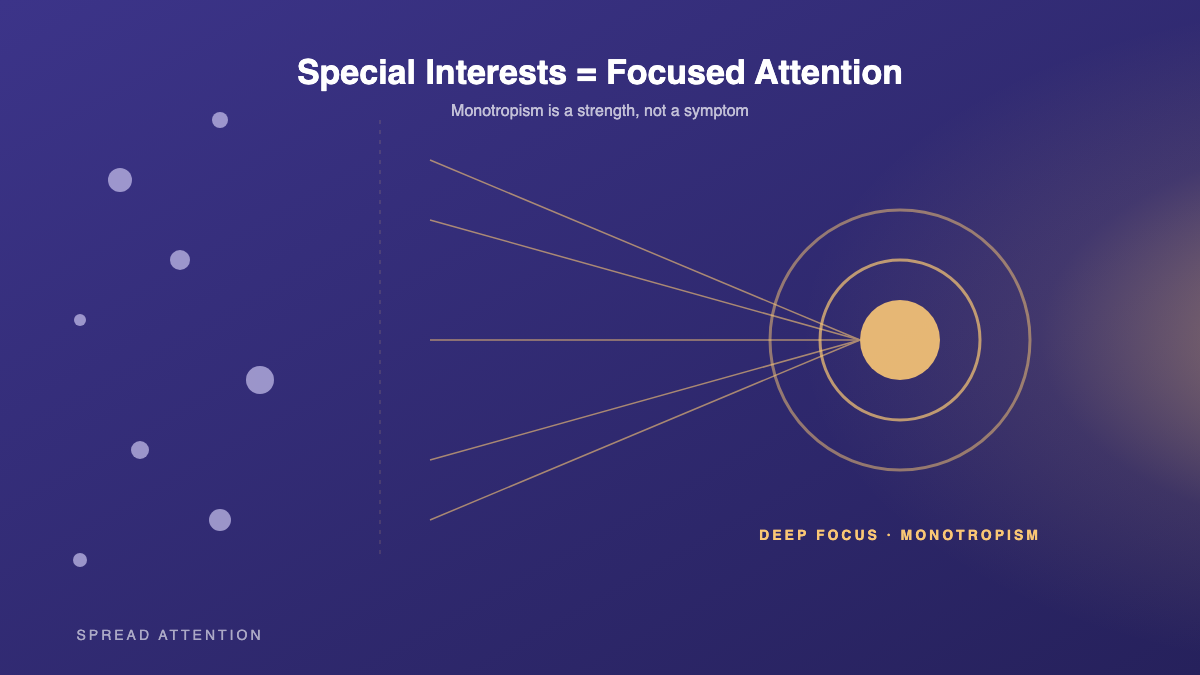
Autistic special interests are not obsessions to be managed away. They are a core feature of how many autistic brains process the world — a phenomenon researchers call monotropism: attention flowing deeply into a narrow channel rather than spreading thin across many. Deep interest is where autistic people often find regulation, expertise, friendships, and careers. The work isn’t to dilute it. The work is to build with it.
This piece is for parents who’ve been told their kid “needs more variety,” teachers trying to reach a student who only wants to discuss one topic, and autistic adults who were taught their passions were a problem. They weren’t. They aren’t.
What science actually says about “special interests”
For decades, autistic special interests were framed clinically as “restricted, repetitive” behaviors — language that quietly cast a strength as a symptom. The newer, more accurate frame comes from autistic researchers themselves.
Monotropism, first articulated by Dinah Murray in 2005 and developed further by Wenn Lawson, Robert Chapman, and others, proposes that autistic cognition tends to pull attention into a small number of highly engaging interests at a time. Neurotypical attention is more polytropic — many shallower channels open at once. Neither is broken. They are different attention economies.
Inside a monotropic flow state, several things happen at once:
- Dopamine is doing its job. Deep interest engagement reliably triggers the brain’s reward and motivation circuitry. This is why an autistic kid can read about trains for four hours and look more regulated afterward, not less.
- Working memory expands inside the topic. Researchers including Laurent Mottron have documented that autistic people often show extraordinary perceptual and memory performance within domains of interest — the “enhanced perceptual functioning” model.
- Sensory and social load drops. A flow state is one of the few places the world stops being loud. That’s not avoidance. That’s a nervous system finally getting a break.
So when a parent or teacher worries that an autistic child is “too into” something, it’s worth asking: too into it compared to what? The neurotypical default? That default isn’t a medical standard. It’s a statistical one.
Why telling an autistic kid to “find balance” usually backfires
“Find balance” is well-meaning advice that doesn’t translate. It assumes a polytropic attention system where you can fluidly toggle between five interests at moderate intensity. Monotropic attention doesn’t work that way. Forcing a switch out of a flow state isn’t a gentle pivot — it’s a hard exit, and it costs.
What it actually costs:
- Regulation. The interest was doing emotional work. Take it away and the work doesn’t disappear; it just shows up as a meltdown, shutdown, or quiet dysregulation later.
- Trust. A child who’s repeatedly told their joy is a problem learns to hide it, not broaden it.
- Skill development. Deep interest is how many autistic people build expertise. Interrupting it constantly is like interrupting a writer mid-sentence — for years.
This is also why we firmly do not recommend behavioral therapies whose goal is to reduce engagement with the interest, including compliance-focused ABA models. Suppressing an autistic person’s primary mode of motivation and regulation is not a neutral act.
“Balance” is a real value — but it has to be built through the interest, not against it.
How to build with the interest, not against it
This is the practical core. The premise is simple: the interest is the on-ramp. Use it.
For parents:
- Tie literacy to the interest. A kid who “won’t read” will often read a 400-page nonfiction book about volcanoes, sharks, or Roblox lore. Reading skills don’t care about the topic.
- Use the interest as a regulation tool, not a reward. Withholding the interest as a behavior lever (“no dinosaurs until you do your homework”) trains your child to associate their main source of calm with scarcity. Let it be available.
- Follow the branches. An interest in Minecraft can branch into geology, redstone logic (circuits), 3D modeling, server admin, or YouTube production. You don’t have to expand the interest — you can expand from it.
- Don’t fake interest, but show up for theirs. Listening to a 20-minute info-dump on Pokémon evolution lines is a love language.
For teachers:
- Let the interest be the medium, not always the subject. A book report on any book they choose, a fractions worksheet themed around their topic, a history project that lets them research the history of their thing — same skill, dramatically more engagement.
- Build “transfer bridges.” When a student is deep in a topic, name the skill they’re using: “You’re doing comparative analysis right now.” This helps them carry the skill out of the topic later.
- Don’t punish the info-dump. Channel it. Give them a presentation slot, a class blog, a five-minute Friday “expert spot.” Their classmates will learn something. So will the student — about being valued.
For autistic adults (and the people who love them):
- Treat the interest as career infrastructure. “Hobbies” framing undersells it. Many autistic adults have built consulting work, writing careers, niche businesses, academic paths, and creative practices directly out of what they were told was a fixation.
- Find your people through it. Communities organized around deep interest — fandoms, research circles, hobby forums, restoration guilds — are often the easiest places for autistic adults to make real friendships, because the shared topic removes the small-talk overhead.
Examples of interests becoming careers, hobbies, friendships
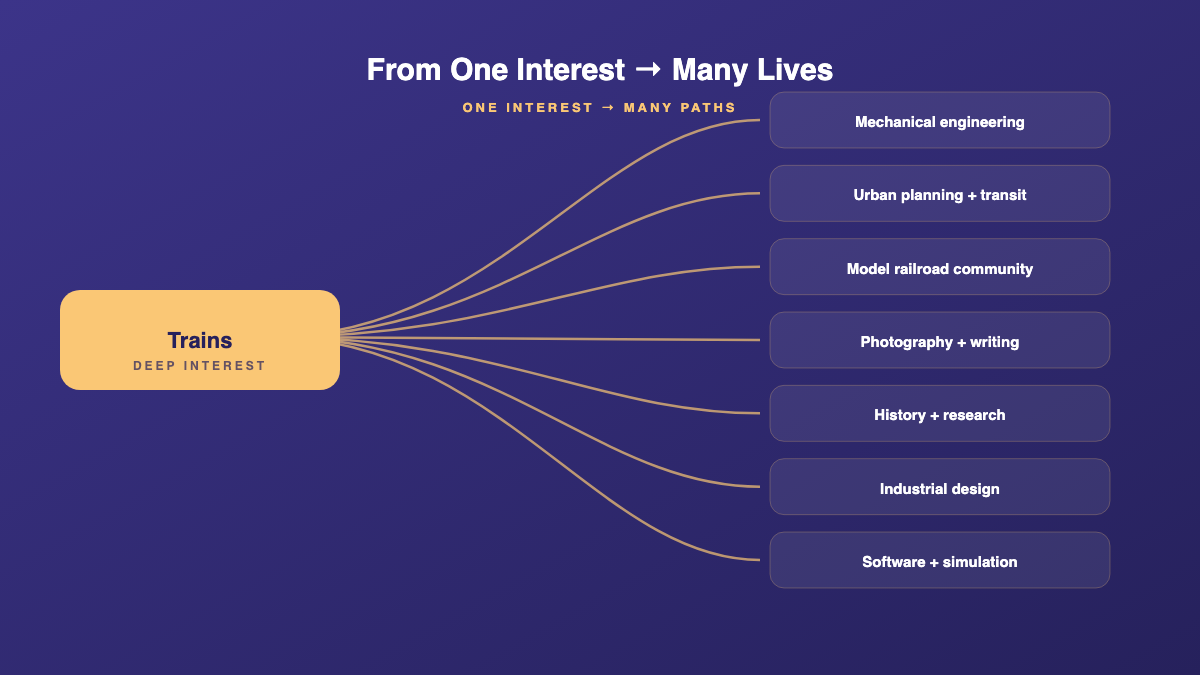
A few real-shaped patterns:
- A child fixated on trains becomes a transit planner, a model-railroad community organizer, or a railway historian.
- A teen who memorizes every video game soundtrack becomes a composer or sound designer.
- An adult told their interest in mushrooms was “weird” runs a small mycology workshop business.
- A kid who draws the same character over and over becomes an illustrator with a recognizable style — which, in art, is the whole game.
Interests also change, and that’s normal too. A six-year-old’s encyclopedic knowledge of dinosaurs may become a teenager’s encyclopedic knowledge of a band, then an adult’s encyclopedic knowledge of historical linguistics. The topic shifts. The mode — the depth, the focus, the joy — usually stays. That mode is the skill.
Tools that channel deep interest without crushing it
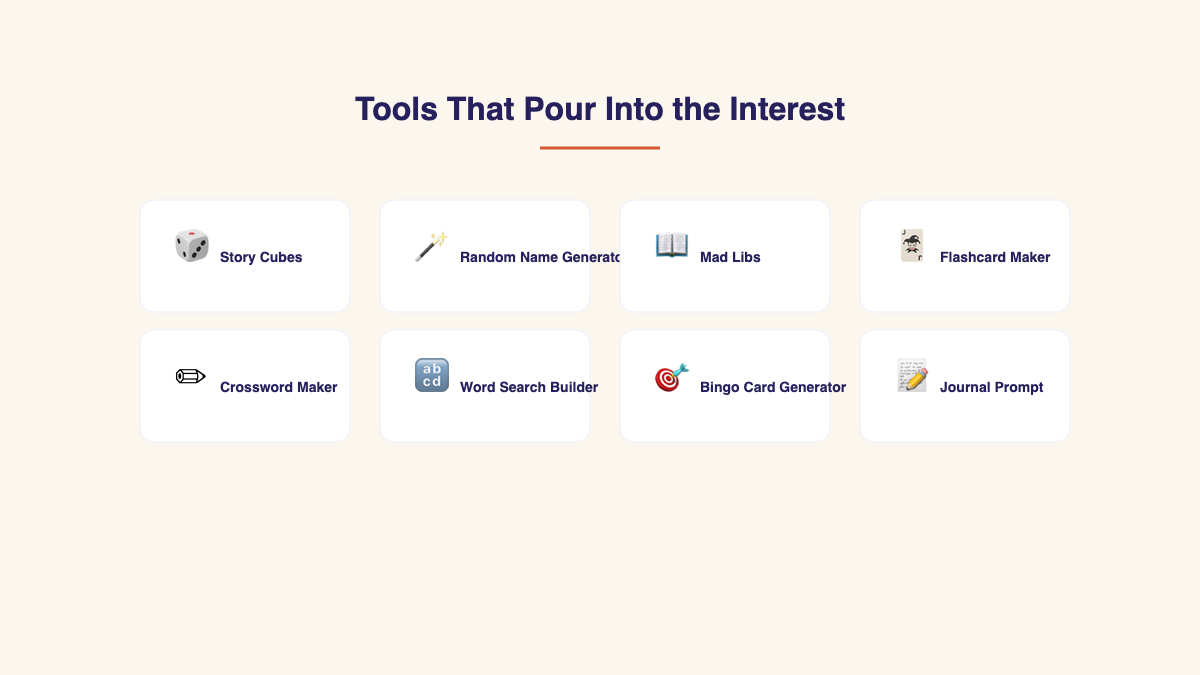
We make a lot of small tools at Not Just a Puzzle, and a quiet design principle runs through all of them: the user supplies the topic; we supply the structure. None of them tell a kid what to be interested in. They give the existing interest somewhere to go.
- Story Cubes — generative writing prompts. Roll, riff, write. Great for autistic kids who love a topic but freeze at “write whatever you want.”
- Random Name Generator — worldbuilding fuel for kid writers building characters around their interest.
- Mad Libs Generator — silly, low-stakes, and a sneaky way to practice parts of speech inside whatever universe the kid already lives in.
- Flashcard Maker — let them dump their entire deep interest into a deck. Bird species, Pokémon stats, planet moons, opera plots, whatever. The act of organizing it is the learning.
- Crossword Maker — invite them to write a crossword for their interest. Creating a puzzle uses different muscles than solving one, and shows them they’re already an expert.
- Word Search Builder — their vocabulary, their puzzle. Excellent low-floor activity for younger kids.
- Bingo Card Generator — themed bingo cards for the family road trip, the birthday party, the classroom. Shared joy around their topic.
- Journal Prompt of the Day — for autistic teens and adults who want a daily on-ramp to writing without committing to a whole project.
When deep interest becomes avoidance — the honest line
It would be dishonest to write this without naming the line. Deep interest is healthy. Pure avoidance dressed as deep interest is not, and it’s worth being able to tell them apart.
Healthy deep interest tends to look like:
- The person comes out of it more regulated, not less.
- They can re-enter normal life (eating, sleeping, hygiene, key responsibilities) — maybe slowly, maybe with support, but the door isn’t welded shut.
- The interest is generative: they’re learning, building, sharing, making.
- They want to talk about it. Joy is involved.
Avoidance dressed as interest tends to look different:
- Engagement feels compulsive and joyless — the person seems pulled in rather than pulled toward.
- It’s specifically displacing something painful: school refusal, untreated anxiety, depression, burnout.
- Sleep, food, and basic care are collapsing, and not just for a day.
- They don’t want to talk about it — they want to disappear into it.
If you see the second pattern, the answer still isn’t “take the interest away.” The answer is to look at what’s underneath. Burnout, sensory overload, an unsupportive school environment, undiagnosed anxiety, and unaddressed trauma all routinely hide behind a screen. Treat the cause. The interest will usually return to its healthy form on its own.
Adults: it’s not too late
A lot of autistic adults reading this were taught, explicitly or implicitly, that their interests were embarrassing — too narrow, too intense, too much. Some of you have spent decades performing breadth you didn’t feel.
You’re allowed to go back. Pick the thing up again. Buy the books, make the spreadsheet, join the forum, start the side project, take the class, refurbish the thing, write the long blog post nobody asked for. Autistic hyperfocus is not less valuable at 45 than it was at 9. Often it’s more — you’ve got the resources now to actually run with it.
The research on autistic burnout strongly suggests that reconnecting with deep interest is one of the most reliable recovery levers we have. It is, quite literally, medicine.
FAQ
Is it bad if my child only wants to talk about one thing?
No. Monotropic attention runs deep before it runs wide. A child who can talk about one topic for an hour is practicing focus, vocabulary, narrative structure, and confidence — all transferable skills. What matters is that someone listens.
What is monotropism?
Monotropism is a theory of autistic cognition, originally proposed by Dinah Murray in 2005, that describes autistic attention as flowing deeply into a small number of interests at a time, rather than spreading across many. It reframes “restricted interests” as a different — not deficient — attention style.
Should I limit screen time around the special interest?
Look at function, not hours. If screen-based engagement with the interest is generative (they’re learning, building, creating, connecting) and they can still sleep, eat, and re-enter the rest of life, the screen is a tool, not a problem. If it’s pure compulsive escape and basic care is collapsing, address the underlying distress — not the screen.
How do I help my autistic student in school when they want to learn ONLY about their interest?
Use the interest as the vehicle for the skill, not the destination. A math worksheet themed around their topic teaches the same math. A book report on a book they chose teaches the same analysis. Over time, name the transferable skills out loud so they can carry them into less-loved subjects.
Do special interests last forever or do they change?
Both happen. Some interests are lifelong; many shift every few months or years, especially in childhood. The depth and focus tend to persist even when the topic changes. Treat each interest as legitimate while it’s here.
Is “special interest” the right word, or is it condescending?
The autistic community is split, and that’s fine. Many people use “special interest” or “SpIn” with pride. Others prefer “deep interest,” “passion,” or just “my thing.” Ask the autistic person in your life what they like. Avoid clinical-pejorative terms like “obsession” or “restricted interest” used as criticism.
Build the world around the interest
If you take one thing from this piece: autistic special interests are not a detour from a good life. For many autistic people, they are the road. Our job — as parents, teachers, partners, and autistic adults ourselves — is to pave it, not block it.
If you’d like more pieces like this, plus practical tools you can use tomorrow morning, grab our free downloads and join the mailing list. We send useful things. We do not send puzzle pieces.
⚡ Reader Club · Free Forever
Join 100s of readers getting puzzle + parenting tips by email.
One short email a week. Free printables, new tools, behind-the-scenes. Unsubscribe anytime.